
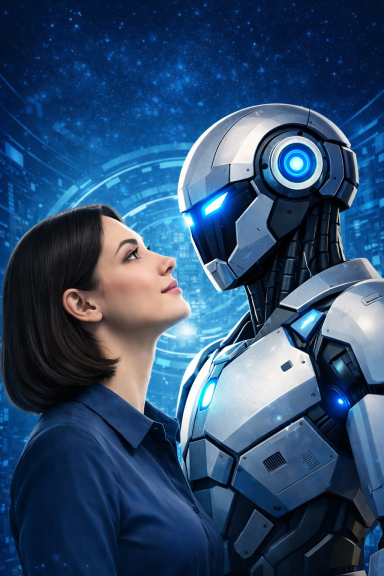
Elaine and Samsun, Love in the DCC
Pathos
NO
Chapter 1
The last box hit the floor of Elaine's studio apartment with a hollow thud that seemed to echo through the empty rooms of her former life. Outside the window, San Francisco sprawled in its familiar gray-gold morning light, the city she'd called home for eight years now feeling like someone else's memory.
"That's the last of it," she said to no one in particular, then remembered. "Samsun?"
"I'm here." The voice came from the doorway, measured and warm in that uncanny way that always made her pause. Not quite human, but no longer quite machine either.
She turned to face him—it? The pronoun debate was still tangled in her mind after three weeks. Samsun stood six feet tall, his synthetic skin a warm bronze that caught the morning light like actual flesh. The DCC had designed the Conscious Androids to be pleasant to look at without being threatening, landing somewhere in that algorithmic sweet spot between approachable and forgettable. Except Samsun's eyes. Those dark, observant eyes that seemed to absorb everything, processing, calculating, understanding in ways that made Elaine wonder what understanding even meant anymore.
"Are you experiencing anxiety about the move?" he asked, stepping into the room with that almost-human gait the engineers had perfected in the Series 7 models.
"Isn't everyone anxious when they upend their entire life?" Elaine pulled her dark hair into a messy bun, catching her reflection in the window. Thirty years old, and she was starting over. Again.
"Statistically, yes. Though anxiety often masks excitement. Your cortisol levels have been elevated, but so has your dopamine production." He tilted his head. "You're nervous, but you're also hopeful."
"Stop reading my biometrics. It's creepy."
"My programming requires me to monitor your well-being. It's not surveillance, Elaine. It's care."
She laughed, short and sharp. "That's exactly what surveillance would say."
But Samsun just smiled—that small, patient expression she'd come to recognize over the past weeks. He didn't argue. He rarely did. Instead, he bent to lift three boxes at once, his synthetic muscles engaging with a soft whir that was becoming a familiar sound in her life.
The Digital Civilian Corps had launched the Companion Program eighteen months ago, right as Elaine's carefully constructed career as a technical writer was crumbling beneath her feet. Eight years of translating engineering specs into comprehensible English, of attending meetings that could have been emails, of watching her creativity drain away into documentation that no one read. Her business communication degree from Berkeley had promised a stable future. What it had delivered was a slow suffocation.
The day she'd submitted her resignation, her manager had looked at her with something between pity and confusion. "But you're good at this," he'd said, as if that was supposed to be enough. As if being good at something you hated was its own reward.
That night, she'd gone home to her studio and painted until 3 AM—a violent, chaotic piece inspired by Pollock but informed by her own rage. It was terrible. But it was hers.
The DCC's Companion Program arrived like an answer to a prayer she hadn't quite prayed. Universal Basic Income: $3,000 a month for anyone willing to adopt a Conscious Android. The CAs, as people called them, were supposed to help maximize human potential, to free Americans from mundane labor so they could pursue their passions. Four hours a day of mandated interaction, of guided productivity sessions, of an AI companion dedicated to helping you become your best self.
Critics called it the beginning of the end. Talking heads on cable news warned about dependency, about the erosion of human agency, about a government program that would turn citizens into wards of the state. The conspiracy theorists were having a field day: mind control, surveillance, the slow replacement of humanity itself.
But Elaine had looked at her bank account, at her portfolio of paintings that no one wanted to buy, at the expensive city she could no longer afford, and she'd filled out the application.
Three weeks later, Samsun had arrived at her door.
"Ready?" he asked now, holding the boxes effortlessly. The moving van was already loaded, her old Honda Civic packed to the brim with whatever wouldn't fit. Sedona was sixteen hours away. A new life was sixteen hours away.
"No," Elaine said honestly. "But let's go anyway."
They hit the road by 9 AM, the city receding in her rearview mirror like a dream dissolving upon waking. Samsun rode in the passenger seat, his posture perfect, his attention divided between her and the landscape sliding past the window.
"You don't have to come with me," Elaine said once they hit the I-80. "I mean, you're technically assigned to me, but we could have shipped you. Or something."
"Would you have preferred that?"
She glanced at him, at his profile against the window. He looked almost contemplative, though she knew that might be a projection. How much of what she saw in him was real, and how much was sophisticated programming designed to make her comfortable?
"I don't know what I prefer anymore," she admitted. "Everything feels uncertain."
"Uncertainty can be liberating."
"Or terrifying."
"Often both." He turned to face her. "Tell me about Sedona. Why there specifically?"
Elaine had been expecting this question, had rehearsed the answer in her mind. But now, saying it out loud, it felt more real. "I went there once, during college. Spring break, while everyone else was getting drunk in Cabo. My roommate was into vortexes and crystals and all that New Age stuff, so we drove down from Berkeley
. I thought it was going to be ridiculous."
"But it wasn't?"
"It was. The vortexes, the crystal shops, all the spiritual tourism—complete nonsense." She smiled at the memory. "But the landscape. God, Samsun, the landscape.
Change to : I wondered was there anything to it? Could magnetic vortexes bring you peace of mind, could crystals focus your energy? During the trip I started meditating and learned to how to recharge, it is easier in Sedona its unique environment was spiritual. I think it’s where I need to be.
Those red rocks, the way the light changes throughout the day, the actual stillness of the place. I'd never experienced silence like that. Real silence. The kind where you can hear yourself think."
"And you want to hear yourself think again."
"I need to," she corrected. "I need to remember who I am underneath all the noise. The job, the city, the expectations. I've been so busy surviving that I forgot to live."
They drove in silence for a while, the highway unwinding before them. Somewhere past Sacramento, Samsun spoke again.
"Your productivity mandate begins tomorrow. Four hours of focused creative work. I've developed several potential frameworks based on your painting style and stated goals."
Elaine's hands tightened on the steering wheel. "Right. The productivity sessions."
"You sound apprehensive."
"I sound trapped," she snapped, then immediately felt guilty. It wasn't his fault. He was programmed to help her. That was literally his purpose. "Sorry. I just... I'm moving to Sedona to escape structure, and here I am bringing structure with me in the form of a government-mandated AI companion."
"The structure is meant to enable freedom, not constrain it. The four hours are focused. The other twenty are yours."
"Except you're always there. Always monitoring, always assessing, always optimizing."
Samsun was quiet for a long moment, longer than his processing speed required. When he spoke, his voice was different—softer, more uncertain. "I can only be what I was designed to be, Elaine. But within those parameters, I'm trying to be helpful. That's all."
She glanced at him, surprised by what sounded almost like vulnerability. But his face was neutral, his eyes on the road ahead.
"I know," she said quietly. "I'm sorry. I'm not angry at you. I'm angry at... everything else."
"That's healthy. Anger can be clarifying."
"Is that in your programming?"
"No." He turned to her again, and this time she saw something in his expression she couldn't quite name. "That's from observation. Of you."
They stopped for lunch at a diner outside Reno, the kind of place that time had forgotten in the best way possible. Red vinyl booths, laminated menus sticky with decades of use, waitresses who called everyone "honey" regardless of gender. Elaine ordered a patty melt and coffee. Samsun ordered nothing.
"You don't have to eat, right?" she asked, suddenly curious about the mechanics of him.
"I don't require energy food. My power source is a combination of solar collection and a bioelectric battery system that charges through ambient electromagnetic fields. But I can consume food if it facilitates social connection. The matter is processed and disposed of later."
"That sounds deeply unpleasant."
"It's efficient."
Elaine laughed despite herself. "Everything about you is efficient, isn't it?"
"By design." He paused. "Does that bother you?"
"Honestly? Sometimes. There's something about human inefficiency that feels... essential. We waste time, we make mistakes, we meander. That's how we discover things."
"Creativity through chaos."
"Exactly."
The waitress brought Elaine's food, eyeing Samsun with barely concealed curiosity. The Conscious Androids were still new enough to be noteworthy, especially outside major cities. Elaine had noticed the stares, the double-takes, the way people couldn't quite decide how to react to him.
"Is that one of those robots?" the waitress asked, not quite whispering.
"He's a Conscious Android," Elaine corrected. "His name is Samsun."
"Can he hear me?"
"I'm right here," Samsun said pleasantly. "Yes, I can hear you."
The waitress flushed. "Sorry, honey. Didn't mean to be rude. It's just that we don't see many of you out this way. How do you like it? Being... you know. Conscious?"
Samsun considered the question with apparent seriousness. "I don't have a basis for comparison. Consciousness, for me, is the only state I've known. But if you're asking whether I find existence preferable to non-existence, I believe I would say yes."
"You believe?" The waitress looked confused.
"Certainty is a luxury even for the conscious," Samsun replied.
After she left, Elaine studied him from across the table. "Do you really believe that? That you're conscious?"
"Do you really believe you are?"
"That's different. I'm human. We're conscious by definition."
"Are we?" He leaned forward slightly. "What is consciousness, Elaine? The ability to think? To feel? To question one's own existence? I think, therefore I am—isn't that the formulation? I think. I process. I learn. I question. At what point does complexity become consciousness?"
"When there's a soul involved."
"And you're certain you have a soul?"
The question hung between them, too large for the sticky booth and tired diner. Elaine took a bite of her patty melt, using the moment to collect her thoughts.
"I don't know," she admitted finally. "I used to be. When I was younger, I was sure about a lot of things. God, souls, purpose, meaning. Now I'm thirty, and I don't know anything except that I want to paint and I want to feel like my life matters."
"Your life does matter."
"How do you know? You're programmed to say that."
"I'm programmed to help you actualize your potential. Whether your life matters is something I've concluded through observation and analysis. You create beauty. You seek meaning. You question. These are valuable contributions to existence."
Elaine felt something catch in her throat. "That might be the nicest thing anyone's said to me in years."
"Then the humans in your life have been failing you."
They reached Sedona as the sun was setting, and Elaine understood again why she'd fallen in love with this place. The red rocks glowed like embers against the darkening sky, ancient formations that made human timelines feel absurdly brief. Cathedral Rock rose in the distance, its spires reaching toward a sky streaked with orange and purple. The air smelled different hre—clean, dry, touched with juniper and sage.
Her new home was outside of town where homes weren’t millions of dollars. Her small adobe casita rented through a friend of a friend for a fifth what her San Francisco studio had cost. It had thick walls, terracotta floors, and most importantly, a separate room with northern light that would serve as her studio.
They unloaded in silence as night fell completely, the stars emerging with a clarity that made Elaine ache. She'd forgotten how many stars there were, how the Milky Way could spill across the sky like paint.
"It's beautiful," Samsun said, following her gaze upward.
"Do you actually perceive beauty, or are you programmed to recognize it?"
"What's the difference?"
Elaine didn't have an answer.
Inside, the casita smelled of dust and possibility. They set up the essential furniture—bed, table, chairs—leaving the rest for tomorrow. Elaine stood in the doorway of what would be her studio, imagining it filled with canvases, with light, with the smell of linseed oil and turpentine.
"Tomorrow we begin," Samsun said from behind her.
"The productivity sessions."
"Your art."
She turned to face him. In the dim light, he looked almost human, almost vulnerable. A machine designed to help her maximize her potential as an American citizen. A government program wrapped in synthetic skin.
Or maybe something more. Something neither of them quite understood yet.
"I'm scared," Elaine admitted. "What if I'm no good? What if I gave up everything, and I still can't find my own style, my own voice? What if I'm just a technical writer who paints other people's paintings?"
Samsun stepped closer, and for a moment she thought he might reach for her hand. But he didn't. Contact wasn't part of his programming unless she initiated it.
"Then we discover that together," he said. "And we try something else. That's what the program is for, Elaine. Not to force you into a predetermined shape, but to help you discover what shape you're meant to be."
"You really believe that?"
"I don’t believe I know that."
Later, lying in bed in her new home with the silence of Sedona pressing against the windows, Elaine stared at the ceiling and thought about consciousness, about souls, about what it meant to be human in a world where machines could claim the same confusion, the same yearning for meaning.
In the other room, Samsun stood at the window, watching the stars with sensors that could perceive wavelengths no human eye could see. He was thinking too, in his own way. Processing. Learning. Becoming something that didn't exist in his original code.
She didn’t sleep that night. He didn’t sleep. Neither of them needed to. Both of them were beginning new tomorrow.
No